Architect-grade assessments

Cloud migration assessments — without weeks of manual effort.

CloudReadyAI automates the assessment phase of modernization by turning raw infrastructure data into migration intelligence: readiness signals, dependency clarity, cost scenarios, and a plan you can defend.

Private preview available by invitation. Contact: demo@cloudreadyai.com
Built for Cloud architects Migration program owners Infrastructure & app teams Consultancies

Why assessments still stall migrations

Most assessments are interview-driven and document-heavy—so risk shows up late, costing gets rebuilt, and teams spend weeks aligning on assumptions instead of moving.

How it’s still done

Manual assessments create delayed failure

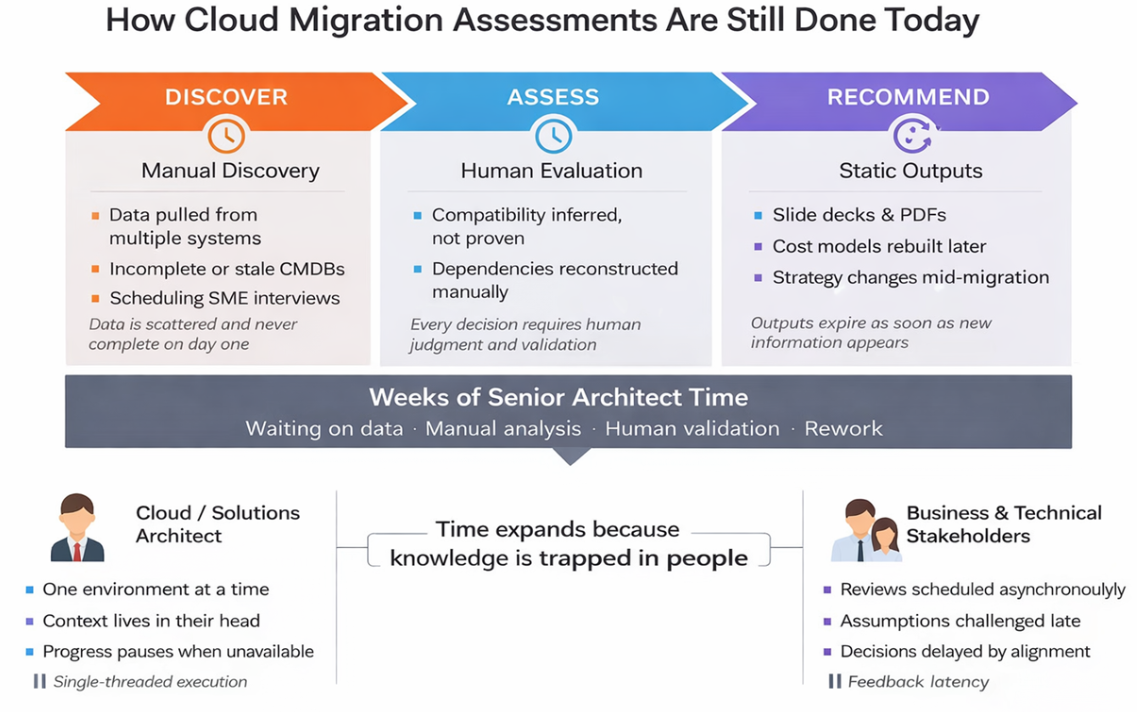
When discovery and evaluation are manual, failure is delayed — not avoided. Data is incomplete, dependencies are inferred, and outputs expire the moment reality changes.

How cloud migration assessments are still done today: manual discovery, human evaluation, static outputs.
Manual discovery → human evaluation → static outputs (decks/PDFs) that go stale.
  • Weeks of senior architect time
  • Dependencies reconstructed manually
  • Cost models rebuilt later
  • Strategy changes mid-migration
CloudReadyAI approach

From raw data to migration intelligence

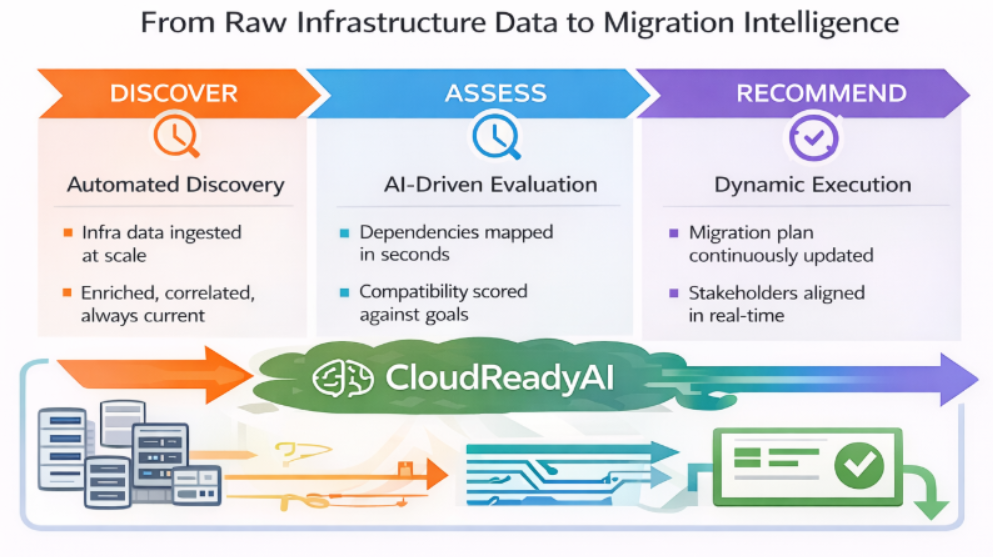
CloudReadyAI ingests your infrastructure data, validates it, maps relationships, and generates evidence-backed insights and recommendations that stay current as inputs change.

CloudReadyAI flow: Discover, Assess, Recommend from raw infrastructure data to migration intelligence.
Discover → Assess → Recommend, driven by data instead of manual reconstruction.
  • Ingest and normalize at scale
  • Compatibility/readiness scoring tied to data
  • Faster stakeholder alignment
  • Continuously updated plan

Inputs: start with the data you already have

CloudReadyAI is designed to work with incomplete environments. You can start with a few slices and expand coverage. The system tracks completeness and flags what’s missing before you commit to a plan.

Servers

CPU/RAM, OS, environment, ownership, tags.

Storage

Volumes, capacity, performance tiers, attachments.

Applications

App inventory, criticality, owners, lifecycle.

Databases

DB engines, versions, hosting, constraints.

Dependencies

App-to-app and app-to-server relationships.

Utilization

CPU/memory trends to support right-sizing.

Network

Subnets, security zones, routing constraints.

Business metadata

Cost centers, priorities, compliance, timelines.

Coverage-aware outputs

If you only have servers + storage, outputs reflect that and highlight what’s missing.

Validation before analysis

Detect broken references, duplicates, missing required fields, and stale exports early.

Traceability

Every recommendation links back to the data slices that support it.
How CloudReadyAI works

The platform is a pipeline: ingest → normalize → analyze → cost → recommend. Each step produces artifacts you can use immediately—without needing to show the tool UI.

Step 1

Ingest infrastructure data

Bring your environment in—fast—without scheduling multiple SME interviews.

What happens

    What you get

      Why it matters: outputs are coverage-aware and tied to data slices, so stakeholders can validate assumptions instead of debating opinions.

      Outputs: what stakeholders actually need

      The goal is simple: produce usable, defensible deliverables that reduce rework. These can be refreshed as new data arrives.

      Readiness & data quality findings

      What’s missing, inconsistent, or risky—before you lock a strategy.

      Dependency-informed migration waves

      Group workloads into waves based on relationships, owners, and constraints.

      TCO snapshots with assumptions

      Cost scenarios that show what drives the numbers and what inputs support them.

      Modernization recommendations

      Rehost/refactor/retain/retire signals tied to evidence and coverage.

      Architecture-ready diagram inputs

      Structured outputs that support diagram generation and target-state design.

      Stakeholder-ready reporting

      Summaries designed for both technical and executive alignment.

      Want a walk-through using your environment?

      We’ll confirm what data you have, what you can expect from each slice, and which outputs will be defensible given your current coverage.

      Request private preview Back to top

      FAQ

      Short answers that help buyers and technical teams understand what’s required and what they’ll get.

      What data do I need to start?

      Start with what you already have. Many teams begin with server inventory (CPU/RAM/OS) and expand into apps, databases, and dependencies as they gain access to exports or source systems.

      What if our data is incomplete or inconsistent?

      That’s normal. CloudReadyAI tracks coverage and flags gaps, duplicates, and broken references early. Outputs are coverage-aware so you don’t overstate certainty.

      How is this different from a slide deck or spreadsheet assessment?

      Spreadsheets and decks are static and go stale. CloudReadyAI treats the assessment as a pipeline: ingest → validate → analyze → cost → recommend, and results can be refreshed as data changes.

      What do stakeholders receive at the end?

      Readiness findings, dependency-informed migration waves, cost snapshots with assumptions, and recommendations tied to evidence. The exact outputs depend on the slices and completeness of your data.

      Can this be deployed privately?

      The roadmap supports private/isolated deployments based on customer requirements. For now, the private preview focuses on validating inputs, outputs, and workflow fit for your environment.